Beyond the lecture hall: What Chinese villages and walls taught about agricultural e-commerce
 बुधबार, १३ श्रावण २०८३, १७:११
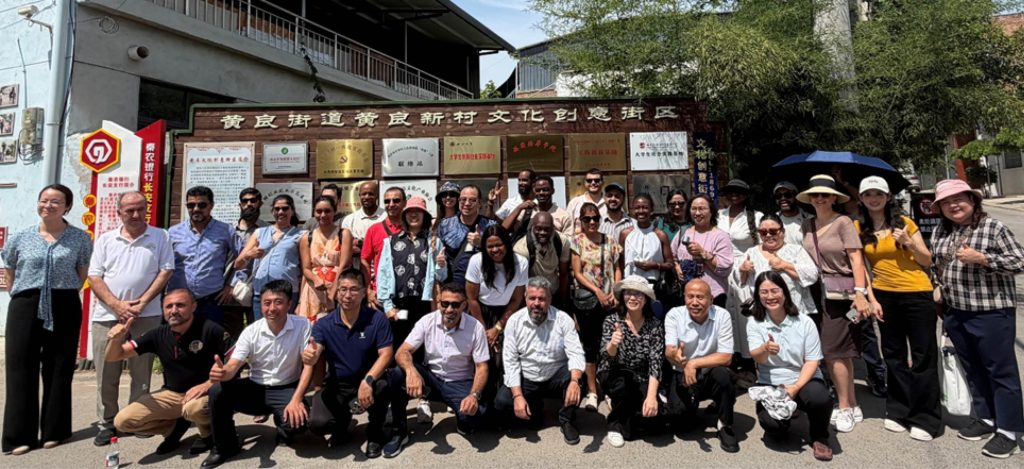

I was invited to a seminar on the Development of Agricultural Products E-Commerce for the Global South, organized by Foreign Economic Cooperation Center (FECC) under the Ministry of Agriculture and Rural Affairs, China from June 29 to July 13, 2026. I thought we would spend two weeks listening to lectures on policy and technology; however, I found something different from what I had expected. The organizers understood a simple truth that many similar programs forget: you cannot exchange experience by only talking to delegates from the stage. Over 14 days in Beijing and Xi’an, the program combined a few classroom lectures with field visits and cultural experiences in China.
The professional lectures covered major topics such as the development model of China, how to build a brand for farm products, and how to maintain strategic development and international relationships. The on-site teachings showed preparation of a suitable eco-friendly climate with regular check-ups of soil and water health, and how China manages artificial intelligence in farming. However, it was the time spent outside the classroom that made these ideas easy to understand. Seeing real places helped us imagine how these ideas could be implemented in a village back home.
The program began with less formality and more fun learning. On the first day, delegates from many developing countries played simple games to get to know each other in a memorable manner. This helped everyone feel comfortable for the following two weeks. Instructors then taught us basic Chinese words and simple tips for daily life in China, such as how to use an online system to book public vehicles, order goods, or greet a shopkeeper. It was a small start, but it set the tone for the entire trip: learn by doing, not just by listening.
No slide in a classroom can truly show what a live-streaming economy is like. However, standing inside the Guononggang Village live-streaming park or the Yunxing live-streaming city in the Pinggu District. We watched small farmer groups sell fruits and vegetables to millions of online viewers. Walking through these studios taught us more about rural e-commerce than any case study could. We saw the cameras, the packing tables set up, and young hosts who had grown up on the farms whose produce they were selling. This mix of growing, selling, and shipping is something that no report can fully explain. This is the challenge that digital village programs in Nepal must first solve.
At the Qinchuangyuan Modern Agricultural Industry Park, and later at Niu Village, Huangliang New Village, and the Shiliuhong Science and Technology Park, we saw how China connects research centers, farmer groups, and delivery networks into a single system. At the Wugong E-Commerce Service Center and the Yangling Agricultural High-Tech Zone, we met local officials and managers who explained, in simple terms, how a farming family moves from growing food only for itself to selling it online. These were not showcases built to impress visitors. These are working models that Nepal can study and adjust to fit its needs. Qinchuangyuan demonstrated how research and business can work side by side. Wugong showed how one county built a service center that small farmers actually use. Yangling showed what several years of steady investment in farm science could achieve.
Cultural trips and sightseeing were just as important, not as a break from work, but as a smart way to build friendships between countries. A walk on the Great Wall and exploration of the old city of Xi’an gave delegates from many countries a shared experience. Friendship between nations is built not only through official agreements but also through shared meals and walks. By the time we reached our final discussion on agricultural e-commerce, we were no longer strangers to each other, trading facts and figures. We were colleagues who walked the same streets and climbed the same walls together.
What surprised me most was how feasible all of this seemed. None of these were expensive, futuristic projects that Nepal could never afford to implement. They were simply good organizations: putting research and business close together, building local service centers, and setting up proper training. Any remote area in Nepal could implement these ideas within its existing budget if there is sufficient will to do so. The lesson for Nepal, where so much needs to be done in the agriculture sector, is simple: as we build our own plans for e-commerce and digital villages, research-based investment is needed, and we should not limit training to conference rooms or online. Ministry staff, cooperative leaders, and local officials need to see working live-streaming villages, service centers, and industrial parks with their own eyes. Visiting these places in person saves years of trial and error. The organizers of this seminar understood something important: agricultural change is learned as much through walking and seeing as through reading reports.
To unlock agricultural potential of Nepal and curb its growing reliance on food imports, the government must aggressively adopt proven small-scale farming innovations of China. By shifting away from a reliance on heavy, impractical machinery and instead investing in small motorized hill-tillers, solar-powered greenhouses, and high-yield hybrid seeds, Nepal can directly address its rugged terrain and climate vulnerabilities. To seamlessly scale this transition, Nepal should pair these physical tools with localized digital agriculture pilots, utilizing AI-driven data and satellite imagery to give smallholders real-time insights on soil health and climate anomalies. Successfully scaling these technologies through regional partnerships will transform subsistence farming into a commercial engine, ensuring food security and economic resilience for millions of Nepalese smallholders.
Looking back, what stays with me the most are the small, human details of the trip. The high-speed trains connected cities within hours, and the five-star airport terminal ran with a calm, quiet efficiency that I still remember. Every flight departed and landed exactly on time. I remember the taste of local dishes served with genuine warmth, the quality of everyday goods in the markets, the comfort of the four-star hotels, and the smooth transport arrangements. Above all, I remember the quiet discipline of ordinary people on the streets and seminar speakers who began and ended every single session exactly when they said they would, without exception. If there is one lasting message from those two weeks, it is: important achievements require time, patience, practical investment and consistent effort to complete.
(Dr. Gunanidhi Pokhrel
Director, Integrate Earth System Consult Pvt. Ltd., Kathmandu, Nepal)